

Table of Contents
- Why Getting Your Bra Fit Right Matters
- How to Measure Bra Size Accurately at Home
- Signs of a Well-Fitting Bra You Should Know
- Understanding Sister Sizes and Fit Adjustments
- Sports Bra Fit for High-Impact Activities
- Common Bra Fitting Mistakes to Avoid
- Getting Your Perfect Bra Fit Right
- Frequently Asked Questions
Last Updated: October 21, 2026
Why Getting Your Bra Fit Right Matters
Finding your perfect bra fit isn't about vanity. It's about comfort, health, and confidence. A poorly fitting bra can cause neck pain, shoulder strain, and back discomfort. It can also dig into your ribs or slip around during movement.
At BettynJoan, we've seen how the right fit transforms everything: women who find their perfect bra fit report less pain, better posture, and more confidence all day.
The problem is simple: most women wear the wrong size. Many have never been properly measured, and others buy for momentary comfort rather than real support.
How to Measure Bra Size Accurately at Home
Measuring at home is straightforward, but the gap between a number that looks right on paper and a bra that fits comes down to variables most guides skip. You need a soft measuring tape, a mirror, and a non-padded bra or no bra, never a padded or molded cup, since padding adds volume that isn't yours and inflates your cup size.
Measuring Your Underbust and Rib Cage
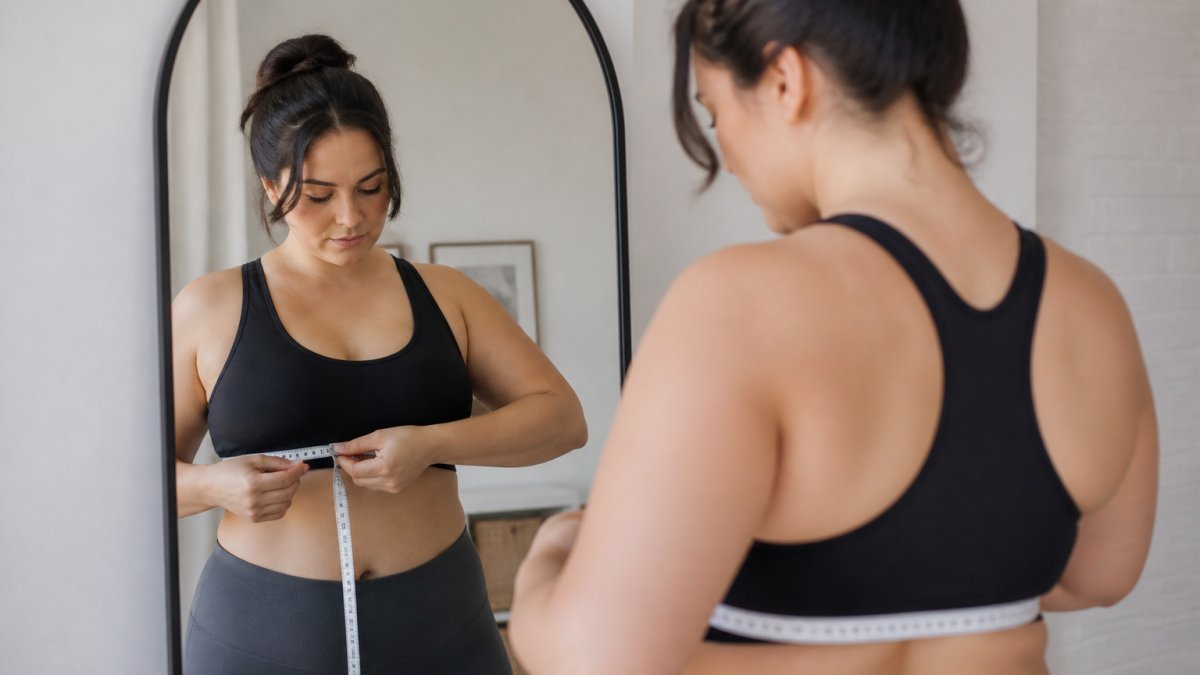
Your band size comes from your underbust measurement. Wrap the tape snugly around your rib cage directly under your bust, parallel to the ground, firm but comfortable, hugging your ribs without digging in.
Write down this number. If it's an even number, that's your starting band size. If it's odd, round up to the next even number. A 33-inch underbust, for example, starts at a 34 band.
Two variables change this number, and competitors rarely mention them:
- Breathe out, not in. Measure at the end of a normal exhale. Measuring on a full inhale adds an inch or more and gives you a band that rides up all day.
- Check the tape level in a mirror. The most common measuring error is a tape that dips at the back. Have someone help, or use a mirror to confirm the tape is level front and back.
Many women pull the tape too tight here, which gives a smaller band size than you need.
Determining Your Cup Size
Cup size comes from the difference between your bust and underbust measurements.
Now subtract your underbust measurement from your bust measurement. Each inch of difference equals one cup size. One inch difference equals an A cup.
For example: If your underbust is 32 inches and your bust is 35 inches, that's a 3-inch difference. You're a C cup. Your size would be 32C.
Breast tissue distribution matters here, and this is where the math stops being enough. Two women can both measure a 3-inch difference and still need different cup shapes.
That's why the measurement is a starting point, not a verdict.
Signs of a Well-Fitting Bra You Should Know
A well-fitting bra should feel like it's barely there, you shouldn't be adjusting it or thinking about it all day.

The Scoop and Swoop Test
The scoop and swoop test reveals whether your cup size is correct. Fasten your bra, reach into each cup from the top to scoop any tissue sitting outside it, then reach under each arm and swoop side tissue into the cup.
After you scoop and swoop, look in the mirror. Tissue should sit smoothly inside the cup with no spillage, and the gore (the center part between the cups) should lie flat against your sternum. If the gore gaps away from your body, your cups are too big; if tissue spills over the top, they're too small.
Checking Band Fit and Strap Placement
Your band should sit parallel to the ground all the way around and shouldn't ride up in the back, if it does, it's too big.
The band should feel snug but not tight: you should fit one finger under it comfortably. Two fingers easily means it's too loose; not even one means it's too tight.
Straps should sit on your shoulders without slipping or digging in. If they constantly slide off, your band may be too big or your straps need adjusting.
Understanding Sister Sizes and Fit Adjustments
Sister sizes are different band and cup combinations that hold the same cup volume. They help you find alternatives when your exact size isn't available and diagnose whether a fit problem is a band or cup problem.
A 34B holds the same cup volume as a 32C or a 36A. If a 34B fits perfectly but you can't find it, try a sister size.
This works because cup volume stays constant. A 32C has a smaller band but a larger cup to compensate. A 36A has a larger band but a smaller cup.
When Sister Sizes Actually Help
Sister sizes are useful in three specific situations:
- Your true size is sold out. If the 34B is gone, a 32C or 36A will hold the same volume and get you close.
- The band fits but the cup doesn't. If a 34B band feels right but the cup is slightly small, a 34C (same band, larger cup) is the direct fix, not a sister size. If the band is too loose and the cup is right, size down the band and up the cup: 32C.
- You're between band sizes. A woman who measures 33 inches may find a 34 band slightly loose and a 32 band slightly tight. Trying the sister size in each direction tells you which trade-off your body tolerates better.
When Sister Sizes Don't Work
Sister sizes are useful but not perfect replacements. A 32C and a 36A hold the same volume, but the 32C band sits tighter, the 36A looser, and the straps are set at different widths. Use sister sizes only when your true size isn't available or as a diagnostic tool.
The trade-off is real: moving down a band and up a cup can feel tight on the ribs; moving up a band and down a cup can give less support and a band that may ride up.
No-Cup Triple-Layer Sports Bra - The Betty →
Fit Adjustments Beyond the Size Chart
Sister sizing assumes symmetrical, average-projection tissue. Two common situations break that assumption:
- Asymmetry. It's common for one breast to be larger than the other. Fit to the larger breast and use the strap and hook adjustments on the smaller side to take up the slack. If the difference is significant, look for bras with removable padding or stretch cups that accommodate the smaller side without gaping.
- Post-surgery or chronic pain. After breast surgery, or for anyone with rib, shoulder, or nerve sensitivity, the standard snug-band rule needs adjusting. A wider, softer band distributes pressure better than a narrow elastic band. Front-closure styles reduce the reach-and-twist motion that strains shoulders. Seam-free cups reduce friction on sensitive or scarred tissue. These are fit adjustments, not size changes, and they matter more than hitting an exact sister-size conversion.
When you buy a sister size, note both the original size and the one that worked. Over time, that record shows which direction your body prefers to trade off band tightness against cup volume.
Sports Bra Fit for High-Impact Activities
Sports bras need different fit standards than everyday bras, prioritizing support and stability over comfort alone.
What Makes a Sports Bra Different
A sports bra reduces breast movement during high-impact activities through encapsulation (individual cup support) or compression. Its band sits higher on your rib cage, and its straps are often closer together than everyday bra straps.
Sports bras also have wider side panels and extended coverage to reduce shoulder strain, with underwire or structure designed to minimize bounce.
BettynJoan's The Betty sports bra, for example, uses triple-layer fabric and a lowered Y-racer back strap to reduce neck tension while providing full coverage and support. The wide band sizing and extended front panels address the specific needs of women with larger busts during high-impact activities.
Testing Support and Coverage
Put on your sports bra and do a movement test: jump, run in place, raise your arms overhead, and move side to side.
Your breast tissue should stay in place. You shouldn't feel excessive movement or bounce. The band shouldn't ride up. The straps shouldn't slip or dig into your shoulders.
Coverage matters too. A good sports bra covers your entire breast without spillage at the sides or top. If you see spillage, you need a larger cup size or better encapsulation.
Common Bra Fitting Mistakes to Avoid
Most women make the same fitting mistakes repeatedly.
Wearing a band that's too big. This is the most common mistake.
Ignoring the gore. The gore should sit flat against your sternum.
Assuming all bras fit the same. Different brands use different patterns and sizing.
Buying based on price alone. A cheap bra that fits poorly will be uncomfortable and wear out quickly.
Forgetting about strap placement. Straps that sit too far apart will slip off constantly.
Not accounting for breast shape. Some bras work better for different breast shapes.
Getting Your Perfect Bra Fit Right
Finding your perfect bra fit is a process, not a one-time event. Your body changes. Bra styles vary. What worked last year might not work now.
Start with accurate measurements. Use the scoop and swoop test. Check that your band sits level and your straps stay in place.
When you find a bra that fits well, note the brand, style, and size as a reference point for future purchases.
Your perfect bra fit should feel supportive without being restrictive, stay in place all day, and never make you think about it or constantly adjust it. When you find that fit, you'll know the difference.
Finding your perfect bra fit transforms how you feel in your body. At BettynJoan, we designed The Betty sports bra with triple-layer fabric, a lowered Y-racer back strap, and extended coverage specifically for women with larger busts who need real support during high-impact activities. Start with accurate measurements, run the scoop and swoop test, and trust what your body tells you about fit. Shop The Betty and experience the difference a truly supportive fit makes.
Frequently Asked Questions
How do you know if a bra fits you perfectly?
A perfect bra fit means the band sits level all around your torso without riding up, the cups fully contain your breast tissue with no spillage or gaps, and the gore (the center panel between cups) lies flat against your sternum. Your straps should stay in place without digging into your shoulders, and you should feel snug support without restriction. The band should be taut enough that you can fit only one finger underneath it.
What is the 2 finger rule for bra fit?
The 2 finger rule means you should be able to slide exactly two fingers under the band of your bra when it's fastened on the loosest hook.
How do you measure your bra size at home?
Measure your underbust by wrapping a measuring tape snugly around your rib cage directly under your bust while wearing an unpadded bra or no bra. Round to the nearest whole number, this is your band size. Next, measure around the fullest part of your bust. Subtract your band size from this measurement; each inch of difference equals one cup size. For example, a 1-inch difference is an A cup, 2 inches is a B cup, and so on.
What are sister sizes and why do they matter for bra fit?
Sister sizes are different band and cup combinations that offer the same cup volume. Understanding sister sizes helps you find better fits if your usual size isn't available or if you experience fit issues. If a band feels too loose, you can size down in the band and up in the cup to maintain the same cup volume. This flexibility is especially valuable when shopping for sports bra fit across different brands.