

Table of Contents
- Why Sports Bra Fit Matters for Large Cup Sizes
- How to Measure for a Sports Bra: Band and Bust
- Sports Bra Size Charts and Sizing Systems
- Encapsulation vs. Compression Sports Bras
- High-Impact Sports Bras for Large Breasts: Support Levels and Features
- Sports Bra Fit Test: How to Know It Fits Right
- Frequently Asked Questions
Last Updated: October 19, 2026
Why Sports Bra Fit Matters for Large Cup Sizes
Finding a sports bra fit large cup that works properly is fundamentally different from shopping standard sizes.
This is where a sports bra fit guide for large cup sizes becomes essential. Most mainstream activewear brands weren't designed with your body in mind: sizing systems max out, cups run shallow, and band widths don't account for the weight and movement larger breasts create during running, jumping, or HIIT.
At BettynJoan, we've built our entire approach around this reality. Proper fit isn't a luxury, it's the foundation of comfortable, confident movement.
How to Measure for a Sports Bra: Band and Bust
Accurate measurement is the foundation of finding your correct sports bra size. Sports bras rely on precise band and bust measurements to determine both band and cup size, and the process is straightforward once you understand what you're measuring and why.
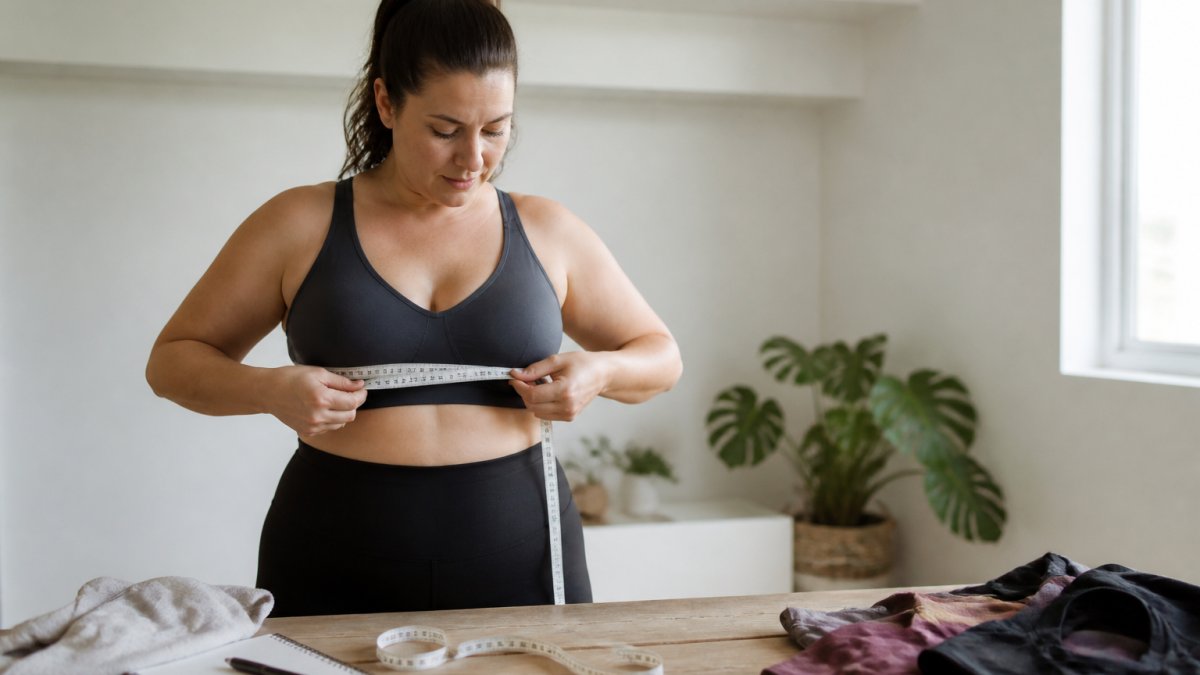
You'll need a soft sewing tape, not a rigid ruler. Wear an unpadded bra or none at all, stand in front of a mirror, and keep the tape snug but not compressed into your skin.
Measuring Your Band Size
Your band size comes from measuring directly under your bust, where the band will sit. Wrap the tape around your ribcage just below your breast tissue, parallel to the ground and snug without pulling tight.
A 32-inch measurement means a 32 band; 36.5 inches rounds to 37. This reflects your ribcage circumference, not your bust, and stays relatively stable unless weight or muscle mass changes significantly.
Measuring Your Bust Size
Your full bust measurement captures the fullest part of your chest. Wrap the tape around your body at nipple level, parallel to the ground, snug but not tight. Record in inches, rounded to the nearest whole number.
The difference between bust and band determines your cup size. For example, a 36-inch band and 42-inch bust gives a 6-inch difference.
Calculating Your Cup Size from the Measurement Difference
Cup sizes increase by one full cup per inch of difference between band and bust, the key principle that makes sizing work across all band sizes.
The standard progression is:
- 1-inch difference = A cup
- 2-inch difference = B cup
- 3-inch difference = C cup
- 4-inch difference = D cup
- 5-inch difference = DD cup
- 6-inch difference = E cup
- 7-inch difference = F cup
- 8-inch difference = G cup
- 9-inch difference = H cup
A 36-inch band with a 45-inch bust gives a 9-inch difference, an H cup, or size 36H.
This works the same whether you're a 32 or 44 band: cup size is always determined by the measurement difference, not the absolute bust measurement.
Sports Bra Size Charts and Sizing Systems
Once you have your measurements, you need to understand how different sizing systems translate them into actual sports bra sizes, confusion here is where many women with larger busts end up in the wrong size.
Band-and-Cup Sizing vs. Alpha Sizing
Band-and-cup sizing expresses your size as a number plus a letter: 36D, 40DD, 42F. It's precise and consistent when ordering online or comparing brands.
Alpha sizing (S-M-L) groups multiple band and cup combinations into broad categories. A "Large" might accommodate a 36DD perfectly but leave a 38G unsupported, which is why it often fails women with larger cup sizes.
For sports bras designed for large cup sizes, band-and-cup sizing is significantly more reliable and lets you compare across brands. BettynJoan uses it because bust size and cup size are distinct variables that both affect fit and function.
| Sizing System | How It Works | Best For | Limitations |
|---|---|---|---|
| Band-and-Cup (e.g., 36D) | Number = band, letter = cup based on measurement difference | Precise fitting, large cup sizes | Requires knowing your measurements |
| Alpha Sizing (S, M, L, XL) | Broad categories combining multiple sizes | Quick selection, simplicity | Often fails for larger cup sizes |
| Numeric Only (e.g., Size 3) | Proprietary numbering system per brand | Brand consistency | Not comparable across brands |
Encapsulation vs. Compression Sports Bras
Design philosophy matters as much as fit. Two approaches dominate the market, encapsulation and compression, and understanding the difference is essential.
Encapsulation sports bras separate and support each breast individually using cups and structured fabric. For larger cup sizes, they reduce bounce more effectively, support high-impact activity better, and create a smoother silhouette.
Compression sports bras flatten the chest against your body with minimal cup structure. It works for smaller cup sizes but becomes problematic for larger busts: the volume of tissue means excessive chest pressure, restricted breathing, and inadequate bounce control during intense movement.
For a sports bra fit large cup, encapsulation is almost always the recommended design, structured support, individual cup sizing, and weight distribution across shoulders and ribcage make it the only realistic option for serious athletic performance.
High-Impact Sports Bras for Large Breasts: Support Levels and Features
High-impact sports bras, designed for running, jumping, and intense cardio, require specific engineering to handle the forces of vigorous movement.
What Makes a Sports Bra Supportive for Large Cup Sizes
Support comes from several elements working together: a band wide enough to distribute weight across your ribcage, cups with enough depth and structure to contain tissue without spillage, and straps positioned to anchor the cups without digging into your shoulders.
Band width is especially critical for large cup sizes.
No-Cup Triple-Layer Sports Bra - The Betty →
Fabric composition matters too. Triple-layer construction, as in The Betty from BettynJoan, provides structure without bulk: the outer layer manages moisture, the middle provides compression and support, and the inner layer comforts skin.

Bounce Management and Strap Design
Bounce management is where the difference between adequate and excellent support shows up. During running, breasts move in a figure-eight pattern with vertical, horizontal, and diagonal components; a poorly designed bra fails to control this, causing discomfort, tissue stress, and constant chest awareness.
Strap positioning directly impacts bounce control. Straps too wide apart allow side-to-side movement; too close together creates shoulder strain.
The lowered Y-racer back, used in sports bras engineered for large cup sizes, addresses a specific problem: traditional strap positioning creates neck and shoulder pain for women carrying larger breast weight.
Sports Bra Fit Test: How to Know It Fits Right
A proper fit test checks multiple points: band position, cup containment, strap security, and performance during movement.
Start with the band. It should sit parallel to the ground, not riding up in the back, and stay in place when you lift your arms overhead.
Next, check the cups.
Straps should sit on your shoulder without slipping; if they slide inward or outward, the band is too large. They should feel secure without digging in.
Finally, do a movement test: jump, run a few strides, or mimic your sport. Your breasts should feel supported and stable, without excessive bounce, migration, or instability.
Signs of Poor Fit and Troubleshooting
Poor fit shows up in specific ways. A band that rides up means your band size is too large, go down one. Gapping or loose cups mean the cup is too large, go down one cup size.
Shoulder pain and neck strain often mean strap positioning doesn't match your proportions, especially common for larger cup sizes wearing bras designed for smaller ones.
If the band digs in or leaves red marks, it's too small, go up one band size. If you can't breathe comfortably, the band is definitely too small.
Fit Changes Over Time and Between Brands
Your sports bra size can change over time due to weight fluctuations, muscle mass changes, hormonal cycles, and aging.
Sizing consistency varies significantly between brands, a 36D from one brand can fit completely differently than a 36D from another.
When you find a brand that fits well, stay with it until your size changes.
Finding the right sports bra fit with a larger bust requires understanding how band size, cup size, and design work together.
At BettynJoan, we've designed our sports bras specifically for women with larger cup sizes who refuse to compromise on either support or style.
Frequently Asked Questions
How should a sports bra fit for large breasts?
A properly fitting sports bra for large cup sizes should have a snug, level band that sits parallel to the ground and doesn't ride up. The cups should fully contain your bust with no spillage or gaps, the straps should sit on your shoulders without digging in, and the bra should feel supportive without restricting breathing. The band should be tight enough to stay in place during high-impact activity but loose enough to slip one finger underneath when fastened on the tightest hook.
What is the difference between encapsulation and compression sports bras?
Encapsulation sports bras have separate cups that support each breast individually, similar to traditional underwire bras, offering maximum lift and shape. Compression sports bras press the bust against your chest, flattening it for a streamlined look. For large cup sizes, encapsulation typically provides better support for high-impact activities because it reduces bounce and distributes weight more evenly across the band and straps.
How do I calculate my sports bra cup size from measurements?
Subtract your band measurement (underbust) from your full bust measurement. Each inch of difference equals one cup size: 1 inch = A cup, 2 inches = B cup, 3 inches = C cup, and so on. For example, if your underbust is 36 inches and your full bust is 44 inches, the 8-inch difference means you wear an H cup. This calculation works the same whether you're shopping for everyday bras or sports bras.
What features make a sports bra supportive for large breasts?
Look for wide straps to distribute weight and reduce shoulder strain, a reinforced band with extended sizing, full-coverage cups that prevent spillage, and encapsulation design for individual breast support. Triple-layer fabric or structured panels provide additional support without excess bulk. A lowered Y-racer back strap reduces neck tension during high-impact activities.
How do I know if my sports bra is too small or too large?
A sports bra is too small if you experience cup spillage, shoulder strap digging, or band riding up during activity. It's too large if the band shifts around your torso, straps slip off your shoulders, or there are visible gaps in the cups. The correct size feels snug and stable without discomfort, and your bust remains fully contained and supported throughout your workout without any movement or bounce.
What type of sports bra is best for high-impact exercise?
High-impact activities like running and HIIT require sports bras with encapsulation design, wide straps, and a reinforced band. Look for bras specifically engineered for high-impact sports with features like reduced neck tension design. For large cup sizes, ensure the bra has extended sizing and full coverage to prevent discomfort and shoulder strain during intense movement.
How do I measure myself for a sports bra at home?
Wear an unpadded bra or no bra and use a soft measuring tape. Measure your underbust (band size) by placing the tape snugly around your ribcage directly under your bust, keeping it parallel to the ground. Then measure your full bust by wrapping the tape around the fullest part of your chest at nipple level, keeping it comfortably loose. Write down both measurements in inches, then subtract the band measurement from the bust measurement to find your cup size.